Chess Bridges: Puzzle
How to use the site
- Click a piece to make it active. It should be highlighted
- With a keyboard: Tab to the board, move between pieces with the arrow keys and press Enter or Space instead of clicking. Escape clears the selection.
- Then click the piece to make a bridge.
- If it is possible to add a bridge, another will be added. If the pair is already at the max, the bridge(s) will be deleted. An invalid pair will do nothing.
- Click the reset button to clear your progress.
- Click the New Puzzle to select a new puzzle from the same or a new difficulty. Already completed puzzles will have a completely green background while partially completed puzzles will be partially green.
- Click the Home button to return to the home for this puzzle.
- If you win, a message should appear allowing you to select a new puzzle.
- Click the Show Solution button right above this message to show the solution. The board is then locked; click Reset to play the puzzle again.
Rules of the Game
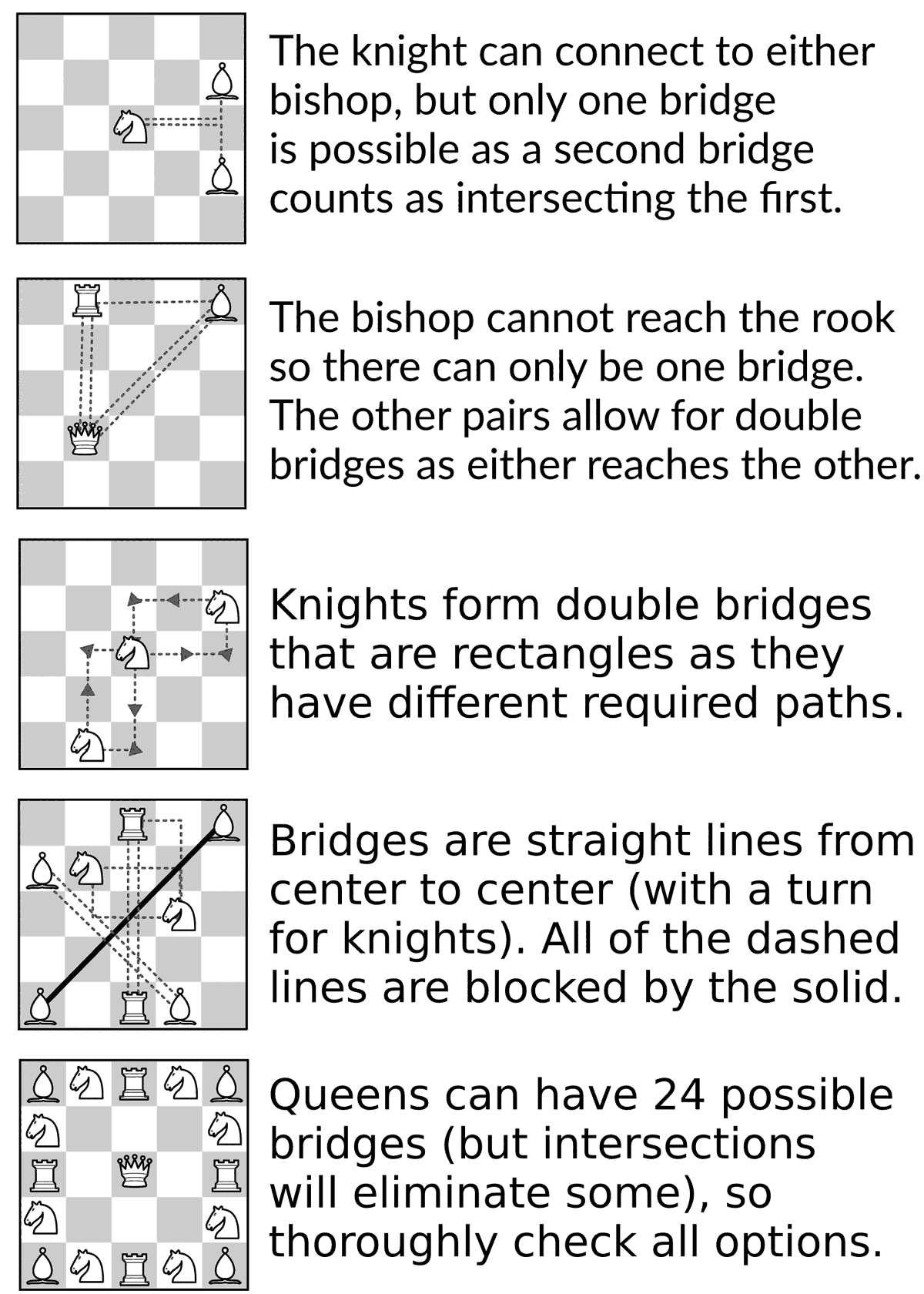
Connect chess pieces with bridges following valid chess moves for each piece. If both pieces can move to the other square, then up to 2 bridges are allowed. If just 1 piece can move, then a max of 1 bridge is allowed.
1. The total number of bridges for each piece must equal the number in its square.
2. Bridges do not intersect each other or another piece.
3. Bridges must connect all pieces into one network.
Valid moves are standard chess moves for queens, rooks, bishops, and knights. Queens can move any distance along rows, columns, or diagonals. Rooks can move along rows and columns. Bishops can move along either diagonal.
Knights cannot jump over pieces like in chess. They move exactly 2 squares along a row and then 1 square along a column or 2 squares along a column and then 1 square on a row. Knights always move the 2 squares first so 2 knights that are connected to each other form a rectangle of bridges rather than a double of one type.
Bridges can move between 2 different types of pieces so you need to check possible bridges in, even if the original piece could not make the move.
For Simple and Easy puzzles, possible bridges are shown as gray, dashed lines. If you are not confident about what bridges are allowed, start with these puzzles.
Examples
Tips & Tricks
1. Find pieces where every bridge needs to be used.
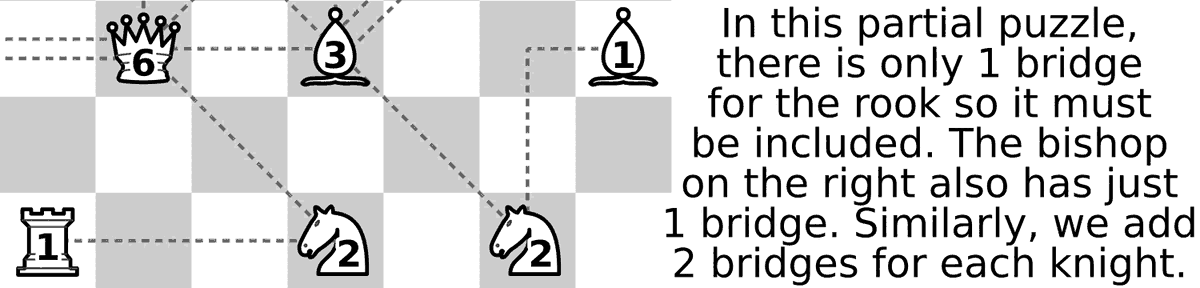
2. Eliminate bridges intersecting an existing bridge.
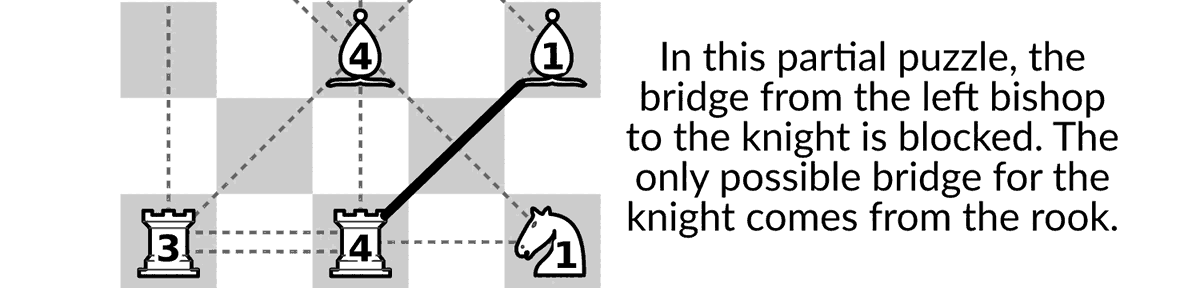
3. Eliminate bridges that make the total exceed the max.

4. Eliminate bridges that block too many other bridges.
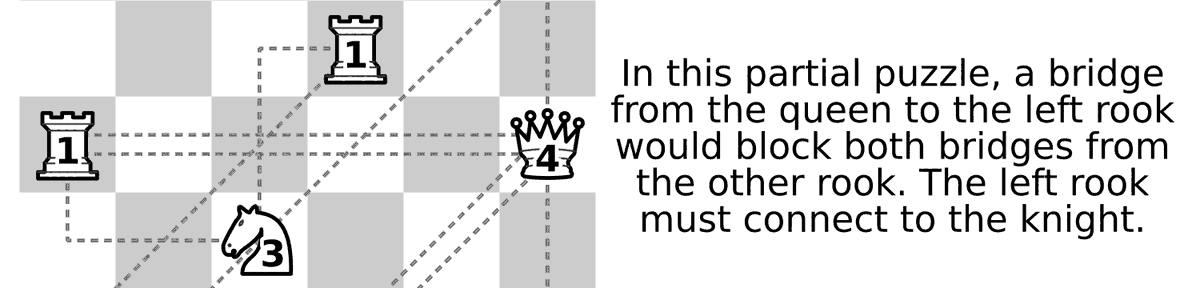
5. Eliminate bridges that disconnect the puzzle. The simplest case is two pieces both having the number 1, but look for other possibilities.

As you eliminate or insert some bridges, recheck all strategies to look for new problems.
2. Eliminate bridges intersecting an existing bridge.
3. Eliminate bridges that make the total exceed the max.
4. Eliminate bridges that block too many other bridges.
5. Eliminate bridges that disconnect the puzzle. The simplest case is two pieces both having the number 1, but look for other possibilities.
As you eliminate or insert some bridges, recheck all strategies to look for new problems.
Congrats, you beat the level!!
Do you want to try another puzzle?
Do you want to try another puzzle?
Tab to the board, then use the arrow keys to move between pieces: left and right go through them in reading order, up and down go to the nearest piece in the row above or below. Press Enter or Space to select a piece, then select a second piece to add a bridge between them; selecting the same pair again cycles through one bridge, two bridges and none. Escape clears the selection.